The Perfect Plan Leaves No Room for Tuesday
A flexible personal plan gives you a clear way to respond when a week changes: set a review point, weigh what you learned, and choose a fitting next step.
You set aside Tuesday evening to compare course options, but a family call runs long and the evening disappears. A flexible personal plan gives you a way to respond: keep the goal in view, check what changed, and decide what to do next instead of treating the interruption as failure.
Think of a plan as a recipe card with notes in the margin. The card keeps the main intention visible; the notes let you adjust an ingredient when the week you have is not the week you expected. A planned review makes those adjustments deliberate.
Choose a live direction
Start with one direction that matters now, not a complete picture of your future. It might be exploring work that uses your writing skills, making regular time for a relative, or finding out whether a training program fits your responsibilities.
Write the direction in a sentence, then add why it deserves attention at this point in your life. For example: “I want to learn whether a part-time design course could fit alongside my current responsibilities.” That sentence leaves room to investigate without implying that you have already decided to enroll.
Your reason is not a contract. It helps you notice when the direction still matters and when you are keeping it only because you wrote it down earlier.
Separate aim from action
Distinguish the broad aim from the route you currently plan to try. The aim may remain important even when its first route proves awkward. If you treat them as the same thing, changing the route can feel like abandoning the aim.
- Aim: What would I like to make more possible?
- Current action: What will I try first to learn or move forward?
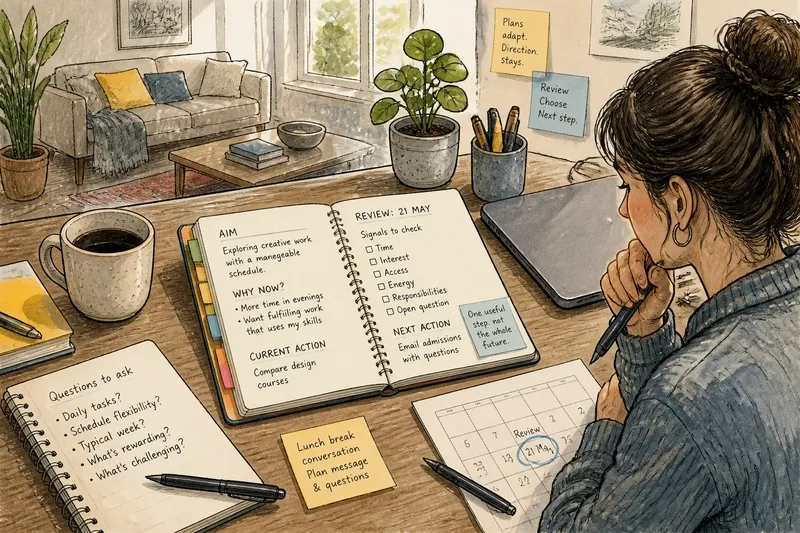
For the design-course idea, the aim might be exploring creative work with a manageable schedule. The first action might be comparing local and online courses. If their schedules do not fit, you can keep the aim and try a conversation with a working designer instead.
A route is a proposal based on what you know today, not a verdict on your ability. Revise it when new information or responsibilities change what is feasible.
Schedule the review
Choose a calendar date or a recognizable event for your review. Add it to the calendar you already use, with a modest block of time. Set it soon enough to affect your next choice, but allow enough time to learn something from the action you chose.
A calendar date works well when the action has no clear finish line. An event, such as finishing a comparison of course options, can work when you are waiting for a specific result or conversation. If that event keeps moving, add a calendar backstop so the review does not vanish.
Write the arrangement plainly: “I will compare course options, then review the aim and next action.” The review is not a reward for finishing everything. It is time to consider what happened, including incomplete work and changed conditions.
Choose useful signals
Decide what observations could help you choose well. This keeps the review from becoming a vague judgment about how productive you were. Use prompts that connect to the aim and the action:
- Time: Did the action fit the time you actually had? If yes, keep its timing; if no, shorten it or choose a more suitable time.
- Interest: Did learning more make the direction feel more relevant, less relevant, or still unclear? If relevance grew, continue exploring; if it faded, revise or pause.
- Access: Could you reach the information or opportunity you needed? If yes, use it; if not, identify the barrier and choose another source or route.
- Energy: Did the action fit alongside the rest of your life? If yes, keep a similar scope; if no, reduce the demand or reconsider the timing.
- Responsibilities: Did a new obligation change what is practical? If yes, adjust the action or review date; if no, keep the current arrangement for now.
- Open questions: What question remains unanswered? If you can name one, choose an action that addresses it; if not, decide whether further exploration is useful or whether to pause.
Keep notes factual. “I could read course descriptions during lunch, but evening classes conflict with a regular commitment” points to a scheduling choice. “I was bad at sticking to the plan” gives you no clear adjustment to make.
Set a small first action
Choose one action that creates movement or information without forcing a decision about your whole future. You might email an admissions office, ask someone about their day-to-day work, or list the questions you still need answered.
Make the action visible. “Explore design” is difficult to schedule and review. “Open two course pages and write down the schedule questions I need answered” has a clear result: a short list of questions to use in a follow-up.
Say you want to explore a career change during a demanding month. You have one former colleague in mind, a spare lunch break, and questions about daily tasks and schedule. You write those questions, send a brief message asking for a conversation, and set a review for the week after the colleague replies. If the conversation happens, your notes can show whether the work sounds appealing and what you still need to learn. If there is no reply by the review, you can decide to contact someone else, use another source, or pause rather than leaving the plan open-ended.
Handle a changed week
Decide how you will respond if the planned time disappears. Depending on the task, move it once, reduce it to a smaller version, or carry it to the review without calling it a failure. The right response depends on what the action requires.
If scheduling a conversation is difficult, a smaller version could be drafting three questions to send by email. If a free evening keeps being claimed by urgent responsibilities, repeated rescheduling is useful information: consider a different time or route.
Do not treat every inconvenient day as evidence that the aim is wrong. But do not use commitment as a reason to ignore a persistent mismatch. The review helps you distinguish a temporary interruption from a condition that calls for a change.
Review a personal plan?
What should I bring to the review?
Bring the original aim, the action you chose, and brief notes about what happened. Include discoveries and obstacles as well as completed tasks, so your decision rests on what you learned rather than a general sense of success or failure.
Should I keep the same direction?
Ask whether it still deserves attention given what you know now. If it does, keep it; if your reasons or circumstances have changed, revise it or set it aside without defending the original wording.
What if I made no progress?
Identify what blocked the action before deciding what the pause means. The task may have been too large, the timing unrealistic, or another responsibility more pressing; choose a smaller action, a different route, or a later review accordingly.
What if I am still unsure?
Keep the uncertainty visible and choose an action that helps you learn. Gather one useful piece of information or talk with someone familiar with the option, then decide at the next review whether it changed your view.
Write the next version
At the review, record what stays, what changes, and the next action. If the aim still matters but the route does not fit, say so plainly. If the aim no longer fits, note what you are choosing instead, including a deliberate pause when that is the right choice.
Set the next review point beside that note. Keep the record short enough to use: a few factual lines can show what you decided and why without turning the plan into another task to maintain.
A flexible personal plan works best when its review changes the next decision, not just the wording on the page. When Tuesday disappears, use what the interruption revealed to choose a time, action, or direction that better fits the week ahead.