A Scenario Is a Question, Not a Forecast
Use a scenario question, not a forecast, to test assumptions about a possible change and choose a useful next move without pretending to know what comes next.
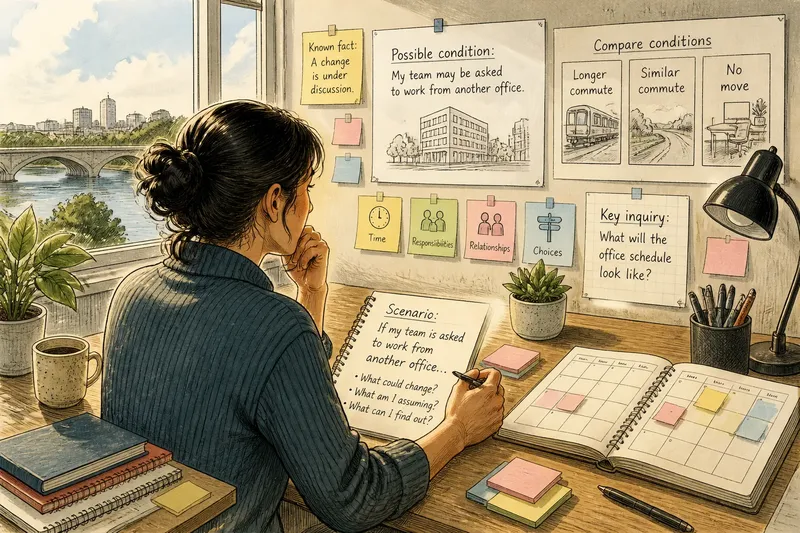
You open your calendar on Sunday night and see a work project filling the next few months. A scenario question, not a forecast, helps you consider what you would do if a particular possibility came to pass. It does not claim that the possibility will happen.
Consider this possible change: your team may be asked to work from another office. You do not know whether that will happen. The useful questions are what the change could affect, which assumptions you are making, and what you might learn before deciding anything.
Possibility and prediction
A prediction states what you expect to happen. A scenario describes one possible situation so you can examine how it might matter. The prediction makes a claim about your expectation; the scenario gives your thinking a specific condition to work with.
“I will work from the other office by autumn” is a prediction. “If my team is asked to move offices, how would the commute affect my week?” is a scenario question. The second does not require you to decide that a move is likely. It asks you to consider what follows if it occurs.
Everyday plans often contain assumptions. You might assume the commute would be longer, your schedule would be fixed, or remote work would no longer be an option. A scenario makes those beliefs visible so you can separate what you know from what you are guessing.
Three ways to think
Choose an approach based on what you need: a current expectation, a way to test an assumption, or a comparison of possible responses.
Use a prediction for an expectation
A prediction can help with a near-term decision that depends on your best current estimate, such as whether to reserve time for a likely meeting. State what you expect and why, then leave room to revise it. For a distant or uncertain possibility, a prediction can sound more settled than your information supports.
Use one scenario to test an assumption
A single scenario works when a possibility is specific enough to imagine but not settled enough to predict. Name one condition, such as a changed office location, then ask what it could affect and what you are assuming. This is useful when you want to spot a dependency without building an elaborate plan.
Compare distinct scenarios
A small set of scenarios can help when different conditions would call for different responses. You might compare a move that lengthens the commute, a move that leaves it much the same, and no move. Keep the set focused: too many variations can turn useful thought into guesswork.
Say you are considering an evening class while your employer discusses a possible office change. For this invented situation, suppose the class meets after work and the commute from the new office is still unknown. First, write down the known fact: a change is under discussion. Next, compare two conditions: your current commute remains workable, or the new commute leaves too little time to reach class. If the class fits only under the first condition, the resulting decision is to ask about the likely office schedule before enrolling, rather than treating either condition as certain.
Write a useful scenario
Make a scenario concrete enough to examine and modest enough to avoid pretending you know more than you do. Write one sentence beginning with “If,” name the possible change, and keep it separate from any claim about likelihood.
- Name the condition: If your team is asked to work from another office, check that the possible change is specific; if it is, examine it, and if not, rewrite it as a clear condition.
- Separate known facts: Check what has actually been communicated; if a discussion is underway, record that, and if nothing has been confirmed, do not describe the move as settled.
- Mark assumptions: Check which details you are guessing, such as commute or schedule; if an assumption could affect your choice, mark it for clarification, and if it would not, leave it out.
- Ask what changes: Check possible effects on time, responsibilities, relationships, or choices; if one affects your priorities, include it, and if none does, narrow or replace the scenario.
- Choose an inquiry: Check what information would clarify the situation; if a person involved can answer, ask them, and if not, note what signal or timing could provide clarity.
- Keep the response reversible: Check whether your next action commits you before the condition is known; if it does, look for a lower-commitment option, and if it does not, proceed while keeping the scenario provisional.
A scenario is like a sticky note beside your calendar: it keeps one possible complication visible, but it does not decide your schedule for you.
Choose the right approach?
When should I make a prediction?
Use one when you need to act on your current best estimate and can name what supports it. Keep it provisional, especially if new information could change your view.
How many scenarios should I consider?
Start with one when you want to test a single assumption. Add another only if it describes a meaningfully different condition that could change your response.
What makes a scenario too vague?
“Everything might change” gives you no specific condition to examine. Name a particular possible change, then ask what it could affect in your circumstances.
What should I do after writing a scenario?
Identify the assumption that matters most and decide whether you can check it now. If you cannot, choose a modest action that leaves room to respond when clearer information arrives.
Choose by purpose
Use a prediction when you need a working expectation for a near-term choice. Use one scenario to inspect an assumption without claiming the possibility is likely. Compare a few scenarios when different conditions would lead to different responses and you need a choice that can accommodate them.
Before acting, ask what would change your view. It might be a confirmed schedule, a direct answer from someone involved, or the passage of time. Keep that signal separate from the imagined situation: the scenario prompts thought, while new information can support a revised decision.
Use a scenario question, not a forecast, to make uncertainty more specific rather than trying to erase it. State the condition, name the assumption, and identify one sensible next inquiry. That gives you a useful basis for thinking without pretending to know what comes next.